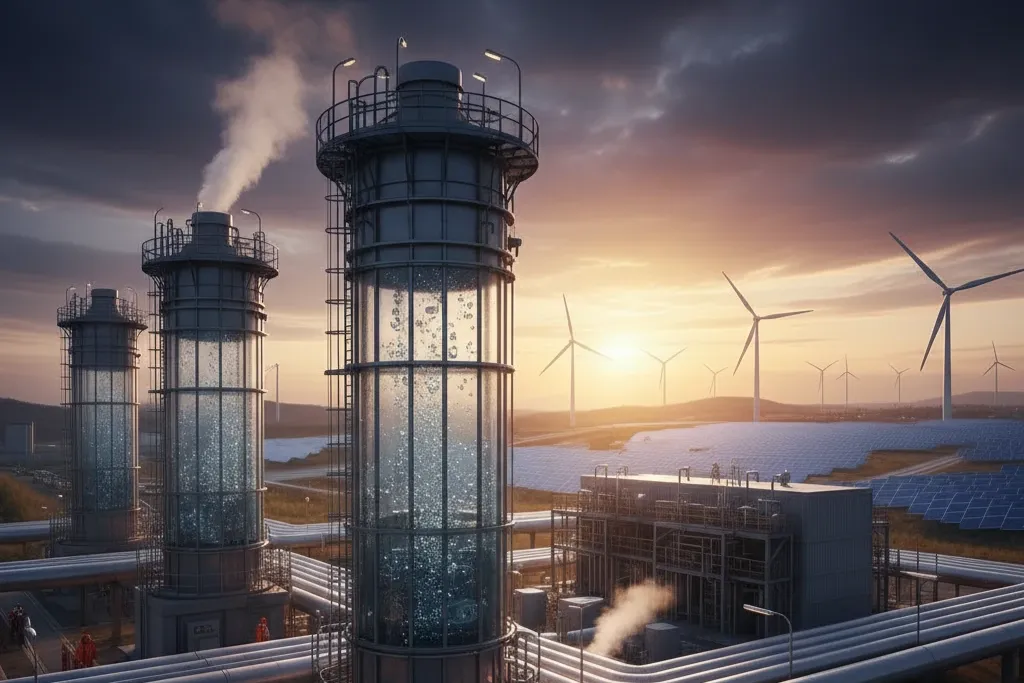




What is the hydrogen economy
The hydrogen economy refers to a future energy system where hydrogen is used as a primary energy carrier instead of fossil fuels. In this model, hydrogen is produced, stored, transported, and used to generate power, fuel industries, and support transportation.
Unlike traditional fuels, hydrogen does not emit carbon dioxide when used. This makes it a critical component in global decarbonization strategies.
Today, governments and energy companies are investing heavily in hydrogen infrastructure to build a cleaner and more resilient energy system.
Types of hydrogen energy explained
Hydrogen is not a single type of energy. It is classified based on how it is produced:
- Green Hydrogen
Produced using renewable energy sources like solar and wind through electrolysis. This is the cleanest and most sustainable form. - Blue Hydrogen
Generated from natural gas with carbon capture systems to reduce emissions. - Gray Hydrogen
Produced from fossil fuels without carbon capture. It is the most common but also the most polluting. - Turquoise Hydrogen
Created using methane pyrolysis, producing solid carbon instead of CO₂.
Among these, green hydrogen is considered the future of sustainable energy investment.
Why hydrogen is important for future energy systems
Hydrogen plays a key role in solving some of the biggest challenges in modern energy systems:
- It enables large-scale energy storage for renewable sources
- It supports decarbonization of heavy industries like steel and cement
- It provides a clean alternative for long-distance transportation
- It reduces dependency on fossil fuels
As renewable energy grows, hydrogen becomes essential for balancing supply and demand in power grids.
Hydrogen investment opportunities
Hydrogen is quickly becoming one of the most attractive sectors for global investment.
Key opportunities include:
- Green hydrogen production plants
- Electrolyzer manufacturing
- Hydrogen transport and storage infrastructure
- Fuel cell technology
- Industrial hydrogen applications
Investors are particularly focused on regions with strong renewable energy capacity and government support.
At this stage, early investment in hydrogen infrastructure offers significant long-term returns, especially in emerging markets.
Countries leading hydrogen development
Several countries are leading the global hydrogen transition:
- Germany → Strong policy framework and industrial demand
- Japan → Hydrogen-focused energy strategy and technology leadership
- South Korea → Investment in hydrogen mobility
- United Arab Emirates → Rapid development of green hydrogen projects
- Australia → Large-scale export-oriented hydrogen production
The Middle East, especially the UAE and Saudi Arabia, is positioning itself as a global hub for hydrogen production due to its renewable energy potential.
Challenges facing hydrogen adoption
Despite its potential, hydrogen still faces several challenges:
- High production costs, especially for green hydrogen
- Lack of global infrastructure for transport and storage
- Energy losses during conversion processes
- Regulatory and standardization gaps
- Need for large-scale investment
However, as technology advances and economies of scale improve, these challenges are expected to decrease significantly.
FAQ
What is the hydrogen economy?
It is an energy system where hydrogen replaces fossil fuels as a primary energy source for power, industry, and transportation.
Is hydrogen a renewable energy source?
Hydrogen itself is not renewable, but it can be produced using renewable energy, especially in the case of green hydrogen.
Which countries invest most in hydrogen?
Germany, Japan, South Korea, UAE, and Australia are among the leading investors in hydrogen technologies and infrastructure.
Can hydrogen replace fossil fuels?
Hydrogen can replace fossil fuels in many sectors, especially heavy industry and transportation, but full replacement will take time and infrastructure development.
Final Insight
The hydrogen economy is not just a technological shift—it is a structural transformation of global energy systems. As investment flows increase and infrastructure expands, hydrogen is expected to become a central pillar of future energy markets.
Management Perspective
“The hydrogen economy is not a distant vision—it is an inevitable transition. Those who invest in hydrogen today are positioning themselves at the core of tomorrow’s global energy system.”
— Dr. Mousa Roshandel, CEO of Aras Holding